
How to Check Criminal History in Dillon County
Choose a source by the fact you need. Dillon Public Index is the first stop for a Circuit Court or General Sessions prosecution. SLED CATCH supplies a paid, name-based South Carolina repository report. Dillon County Detention Center and South Carolina VINE address current local custody, while SCDC covers people who are serving a state prison sentence. SORT is a separate registry tool. None of those sources replaces the report kept by the agency that made an arrest.
Gather the full legal name, date of birth, known aliases, a case or incident number, and a narrow date range. Use an exact case number when one is known. A name result should be checked against the court, filed date, charge, and agency before it is treated as the right person.
- Define whether the goal is a court case, state history, booking status, police report, supervision record, or registry entry.
- Search the matching official system with the most exact identifier available.
- Read the source limits before treating a no-hit as meaningful.
- Compare the docket, custody source, and creating agency when dates or results conflict.
- Call the clerk or record custodian for certified, old, omitted, or non-downloadable material.
The Judicial Branch Dillon court directory shows the official court routing used in Dillon County.
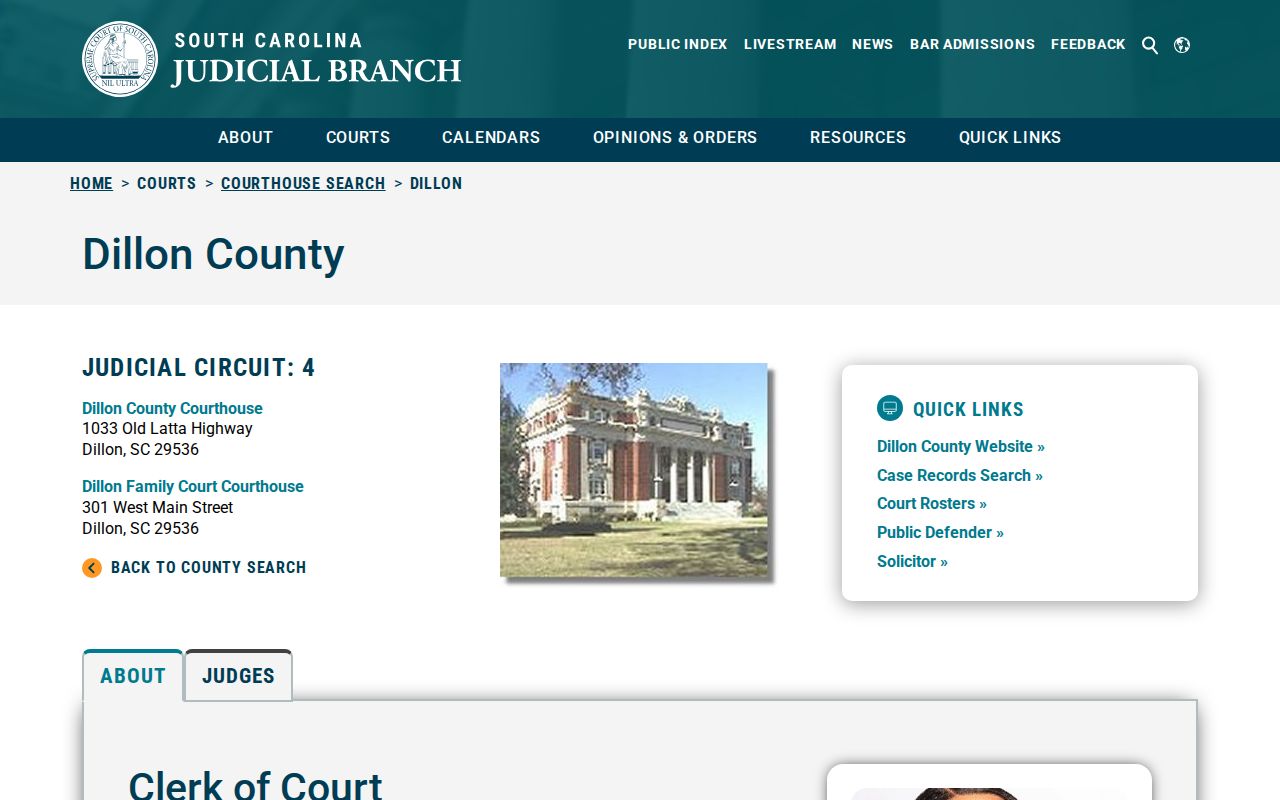
That directory helps separate General Sessions, Bond Court, Magistrate Court, and each municipal court before a request is sent.
Four Dillon County Criminal Record Systems
Dillon County criminal history is not one master public file. Public Index describes a prosecution. CATCH summarizes fingerprint-supported South Carolina arrest and disposition data reported to SLED. VINE reports custody status and offers notice of changes. SCDC Inmate Search covers a different group: people currently sentenced and incarcerated in the state prison system.
Record path: arresting agency report › Dillon County booking or bond record › the correct criminal court docket › reported SLED repository cycle › state custody or supervision when ordered.
Public Index answers what happened in a General Sessions case, but it is not a statewide rap sheet. CATCH answers what appears in the public state product, while excluding wanted and registry data. VINE can confirm reported local custody and provide status notice, but it is not a booking file. SCDC Inmate Search covers current state prisoners and excludes county detainees and supervision-only cases.
The official Dillon Public Index screen is the county case-search layer in that comparison.
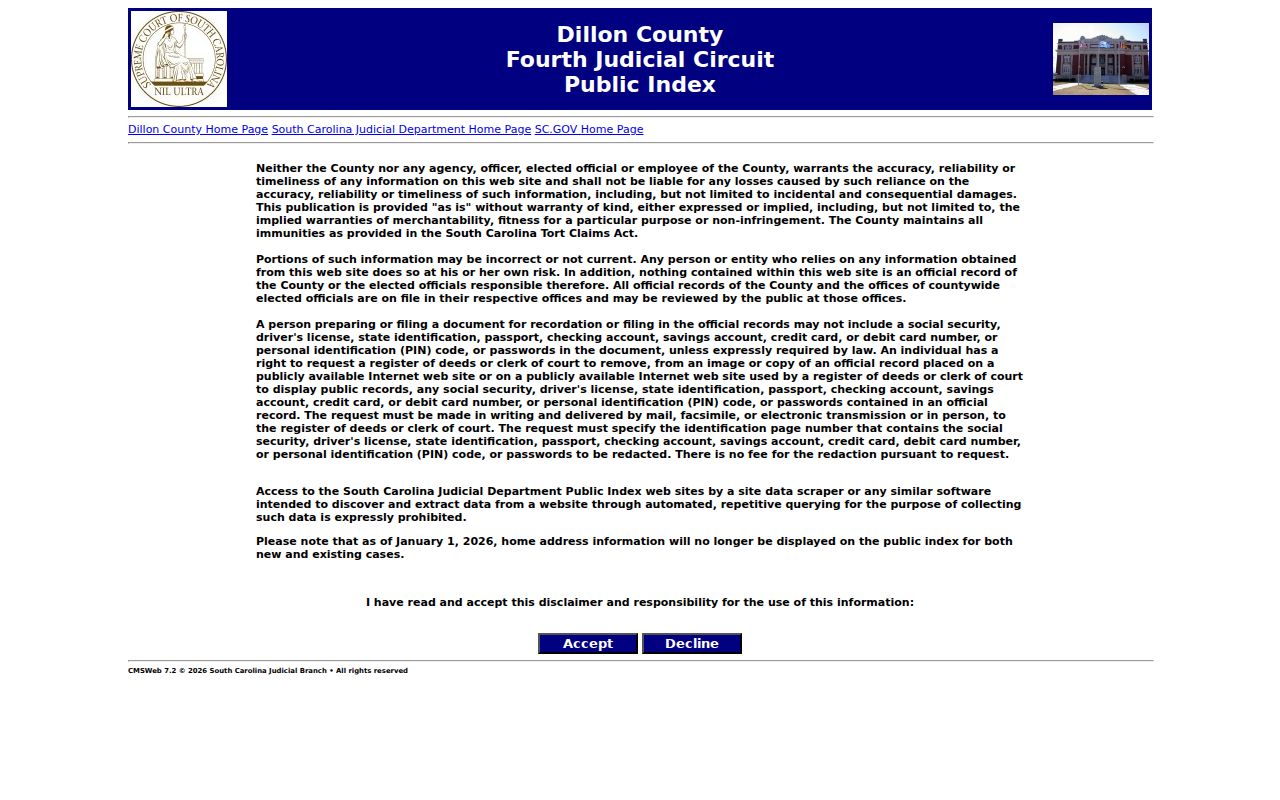
A sound Dillon County criminal record search uses only the rows that fit the question. It then checks the original office when a filed document or certified copy matters.
Official South Carolina Background Checks
The South Carolina Law Enforcement Division runs SLED CATCH. A public CATCH report is a South Carolina-only name search, not a fingerprint-confirmed national check. The nonrefundable base charge is $25. A notice effective July 1, 2026 adds a $1.43 online service fee to that report, though the live checkout total should be confirmed because older convenience-fee text remains on the service.
Mail is also available through the official criminal record check form. The requester encloses $25 by an accepted certified or business instrument, a self-addressed stamped envelope, and a clear request for certification or notarization when needed. Mail avoids the online fee. For personal FBI review, the subject can use the fingerprint-based FBI electronic Identity History Summary channel. SLED authorizes noncriminal fingerprint checks only where law requires or permits them; IdentoGO Print-and-Go or a local law-enforcement fingerprint-card service may capture prints.
| Channel | Known cost | Coverage |
|---|---|---|
| CATCH online | $25 plus current online service fee | Name-based South Carolina repository report |
| CATCH by mail | $25 | Same state product without the online fee |
| Qualifying reduced report | $8 plus announced $1.14 service fee | Only the statutory qualifying channel |
| Fingerprint card or FBI self-check | Confirm with the official provider | Identity-based service, distinct from a Dillon court docket |
The captured SLED CATCH screen shows the official entry point for a Dillon County criminal history name check.
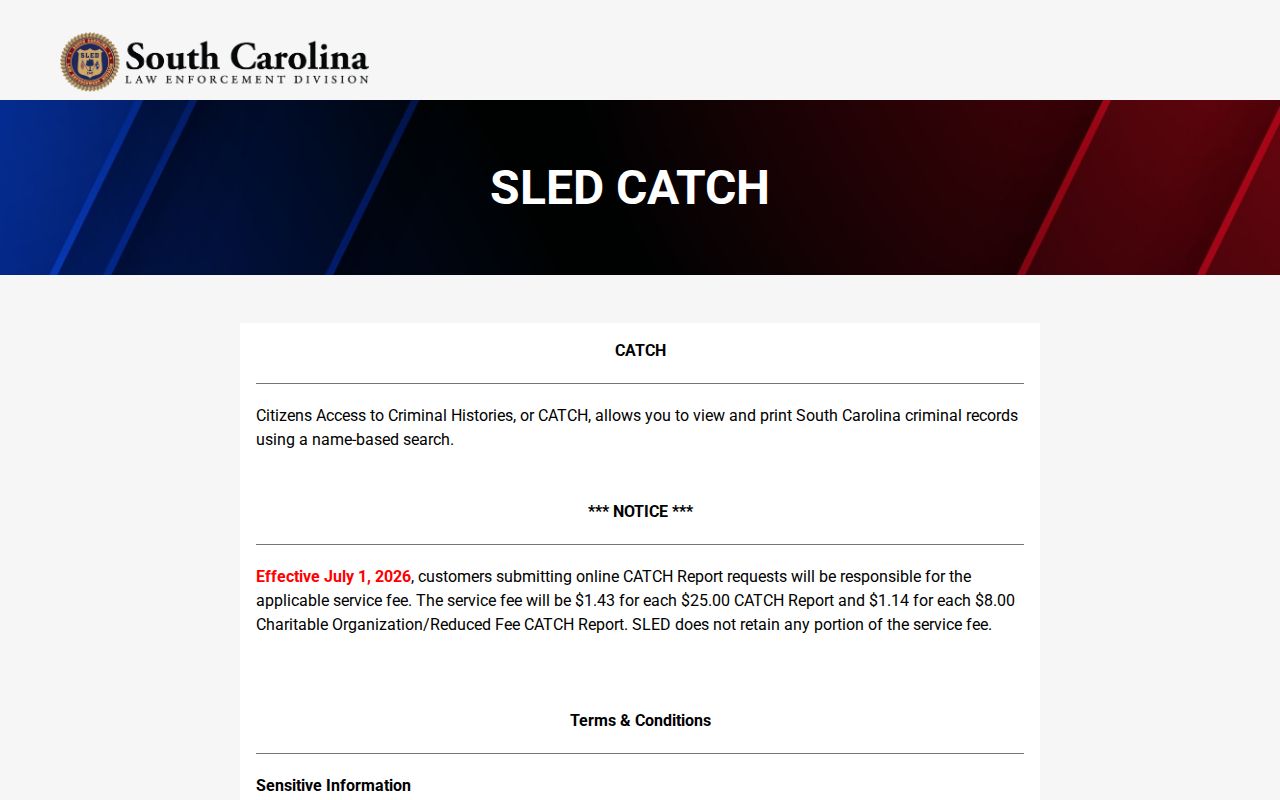
Its terms and search rules should be read before payment because the charge is nonrefundable and a name match is not fingerprint proof.
Dillon County CATCH Search Limits
CATCH uses a starts-with match on last name, first name, and date of birth. Middle name can narrow the search, and Social Security number is optional but searched when supplied. A stored alias or different birth date can lead to a false no-hit. Several possible subjects can trigger special processing. The service excludes wanted-person information and South Carolina Sex Offender Registry data.
| Field | Status | Search behavior |
|---|---|---|
| Terms acceptance | Required | Must be accepted before the search continues |
| Last and first name | Required | Starts-with matching |
| Date of birth | Required | Matched with the name |
| Middle name | Not stated as required | Can narrow similar names |
| Social Security number | Optional | Searched when entered |
SLED's Criminal Justice Information Services page describes how arrest, court, and custody data reach the central repository.
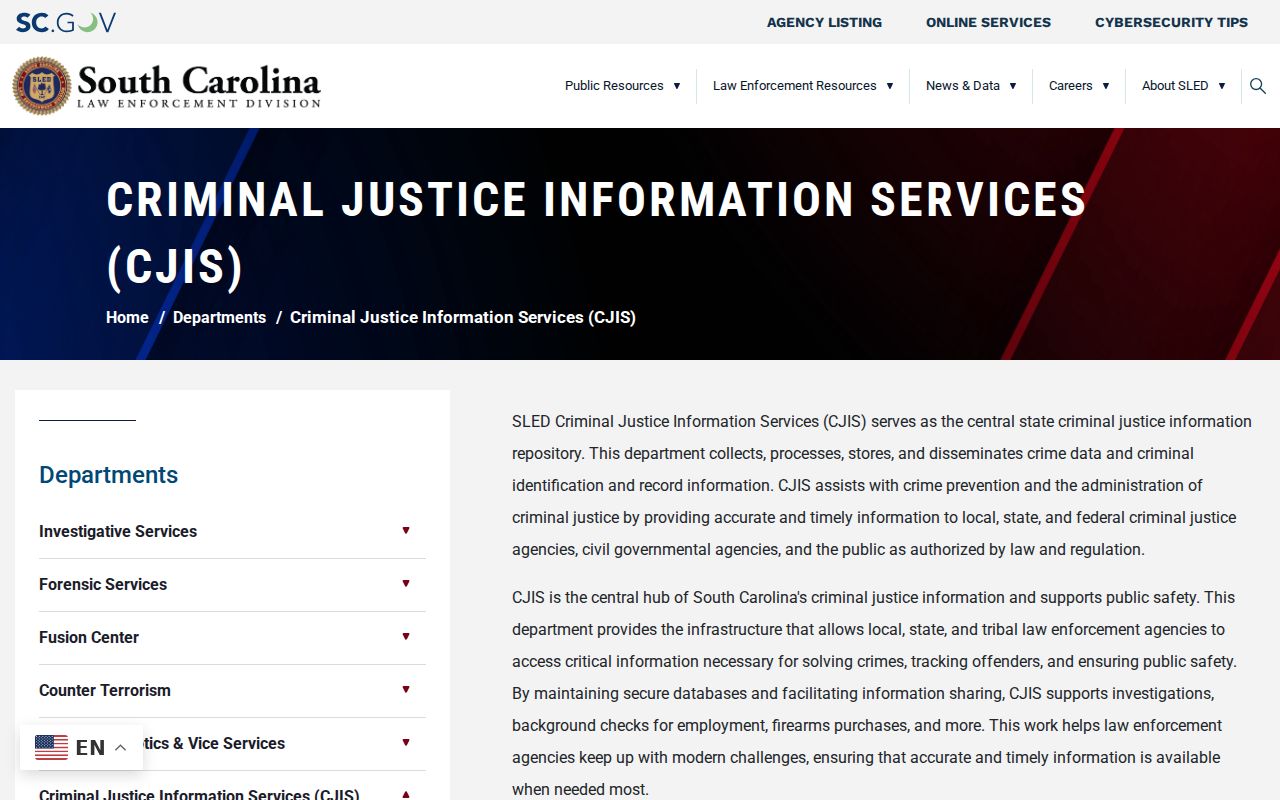
The repository view is useful, but it should be compared with the Dillon County court file when a charge or final result is the key fact.
Types of Criminal Records in Dillon County
Dillon County agencies create separate records at each stage. An incident report records an allegation and response. A booking file marks intake and custody. A court file tracks charges, hearings, disposition, and sentence. SLED assembles reported fingerprint-supported cycles. Corrections and supervision systems then describe custody or community oversight within their own scope.
- Arrest and booking records: the arresting agency holds its report, while Dillon County Detention Center keeps the local intake and custody file.
- Criminal court cases: the Clerk keeps General Sessions files; Magistrate and Municipal Courts keep matters within their own jurisdiction.
- Repository history: CATCH draws on qualifying South Carolina arrest and disposition submissions to SLED.
- Warrants: the issuing court and serving agency are the right sources because Dillon County has no official public warrant database.
- Custody and supervision: county detention, SCDC prison, and SCDPPPS probation or parole are three distinct layers.
- Registry records: SORT publishes legislatively authorized information about qualifying registrations and is separate from CATCH.
The official Dillon County government directory is a useful route to the sheriff, courts, detention office, and other county custodians.
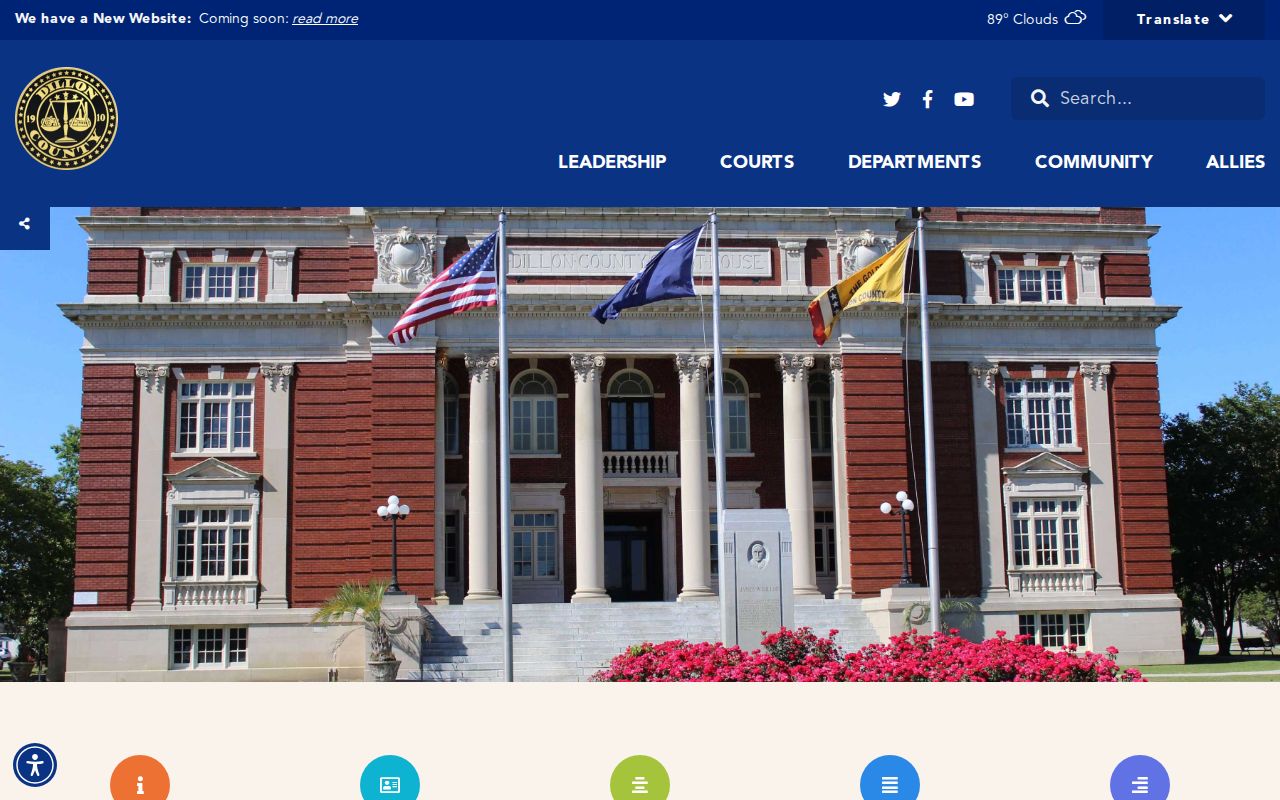
Agency names and telephone fallbacks matter because the county site was preparing a new website when the research was completed.
Dillon County Jail and State Records
Dillon County Detention Center is not SCDC. The local facility at 1027 Old Latta Highway holds county detainees and may be reached at 843-774-1435 or 843-841-3730. No official Dillon County jail roster or booking-log interface was found. Current custody research therefore starts with the facility phone and South Carolina VINE, followed by a narrow Sheriff or detention FOIA request for releasable booking data.
SCDC Inmate Search is refreshed to midnight of the prior day. It covers people who are currently sentenced and incarcerated in South Carolina state prisons. It excludes county detainees, released people, people on probation or parole only, juveniles, and current SCDC fugitives. Its scope notice should be read before using the public locator. SCDPPPS has a separate search for active probation or parole supervision.
SCDPPPS Offender Search reports prior-day supervision data, not county jail custody or the signed sentencing sheet.
Note: Call the detention center to confirm urgent custody because transfers, releases, and electronic feeds can change.
What a Dillon County Criminal Record Shows
The contents depend on the record. A Dillon County court docket can show the charge filed, event history, counsel, disposition, sentence, and financial entries. A repository report can group identity and fingerprint-supported arrest cycles. An incident report may contain a narrative, evidence references, and investigative material that is redacted or withheld by law.
| Name and identifiers | Legal name, aliases, date of birth, and authorized state or fingerprint identifiers. |
|---|---|
| Arrest and booking | Date, agency, intake charges, warrant or booking identifiers, bond, custody, and release or transfer fields. |
| Charge data | Offense allegation, statute or CDR code, filed date, and later amendments. |
| Disposition | Conviction, dismissal, acquittal, nolle prosequi, plea, or other court result. |
| Sentence | Incarceration, suspended time, probation, fines, and other terms reported by the court. |
| Status | Custody, case, or supervision status as defined by the particular system and update date. |
A charge is an allegation. A disposition is the court's result. A docket label is also not the signed order behind it, so the Dillon County Clerk remains the source for an authoritative filed document.
Dillon County Criminal Record Gaps
SLED reported on July 20, 2026 that only seven percent of direct indictments from 2025 through its report date had entered the state repository. The agency linked the gap to defendants who had not been fingerprinted and described courthouse scanner pilots and CCH redevelopment. A direct indictment can therefore appear in Dillon County court records without a complete matching CATCH cycle.
That warning changes how a no-hit should be read. Compare CATCH with Dillon Public Index and the clerk. Check alternate spellings and aliases. If a disposition is missing, obtain the certified court result and use SLED's correction or challenge process. A person whose expungement still appears can send SLED a certified true copy of the order, a recent purchased report, and a stamped return envelope under the agency's instructions.
The official SLED fingerprint-gap update provides the source for this Dillon County criminal history caution.
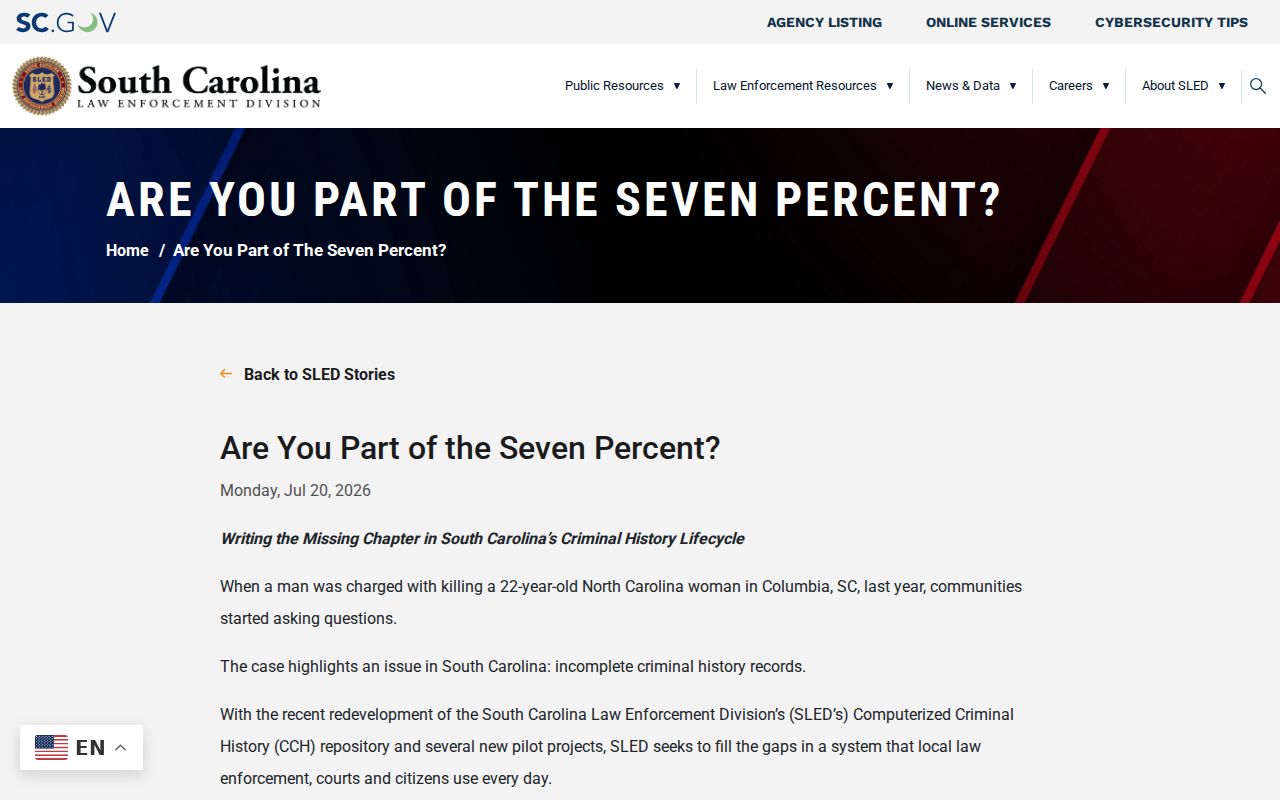
The image reinforces why court, repository, custody, and agency sources should be compared instead of merged into one assumed record.
Public Access Laws for Dillon County Criminal Records
The South Carolina Freedom of Information Act governs many requests to Dillon County custodians, but it does not make all criminal material public. The law permits reasonable actual search, retrieval, redaction, and production costs. An agency may ask for a deposit of up to 25 percent of the expected charge. It also must separate nonexempt material when possible.
Key South Carolina laws:
S.C. Code § 30-4-30 sets request response periods, production rules, deposits, and reasonable fees.
S.C. Code § 30-4-40 protects defined law-enforcement and privacy-sensitive material.
S.C. Code § 23-3-115 permits individual history dissemination while barring sale of the database as a whole.
S.C. Code § 23-3-120 requires qualifying fingerprint and arrest submissions.
S.C. Code § 17-1-40 controls destruction and sealed retention after qualifying expungements.
Victim-sensitive information, medical data, Social Security numbers, juvenile files, sealed records, and qualifying active-investigation details remain restricted. The custodian should cite the basis for withheld material.
Dillon County Criminal Records by FOIA
No separate Dillon Sheriff records form, local clearance product, or county copy-fee schedule was found. A focused written request is the practical fallback for a releasable incident or booking record. Address it to the agency that created or maintains the file. Include the incident, case, or booking number when known; otherwise give a narrow date range, person or location, record type, and desired delivery format.
For records no more than 24 months old, the public body generally has ten business days to notify the requester of its determination. The period is generally twenty business days for older records. That is a decision deadline, not a promise that every record will arrive in ten or twenty days. Ask for the current fee schedule and an estimate before work begins.
Dillon County Clerk of Court
301 West Main Street
Dillon, SC 29536
843-774-1425
Monday through Friday, 8:30 a.m. to 5:00 p.m.
Dillon County Detention Center
1027 Old Latta Highway
Dillon, SC 29536
843-774-1435 or 843-841-3730
The Dillon County Clerk page confirms the court office and its records role.
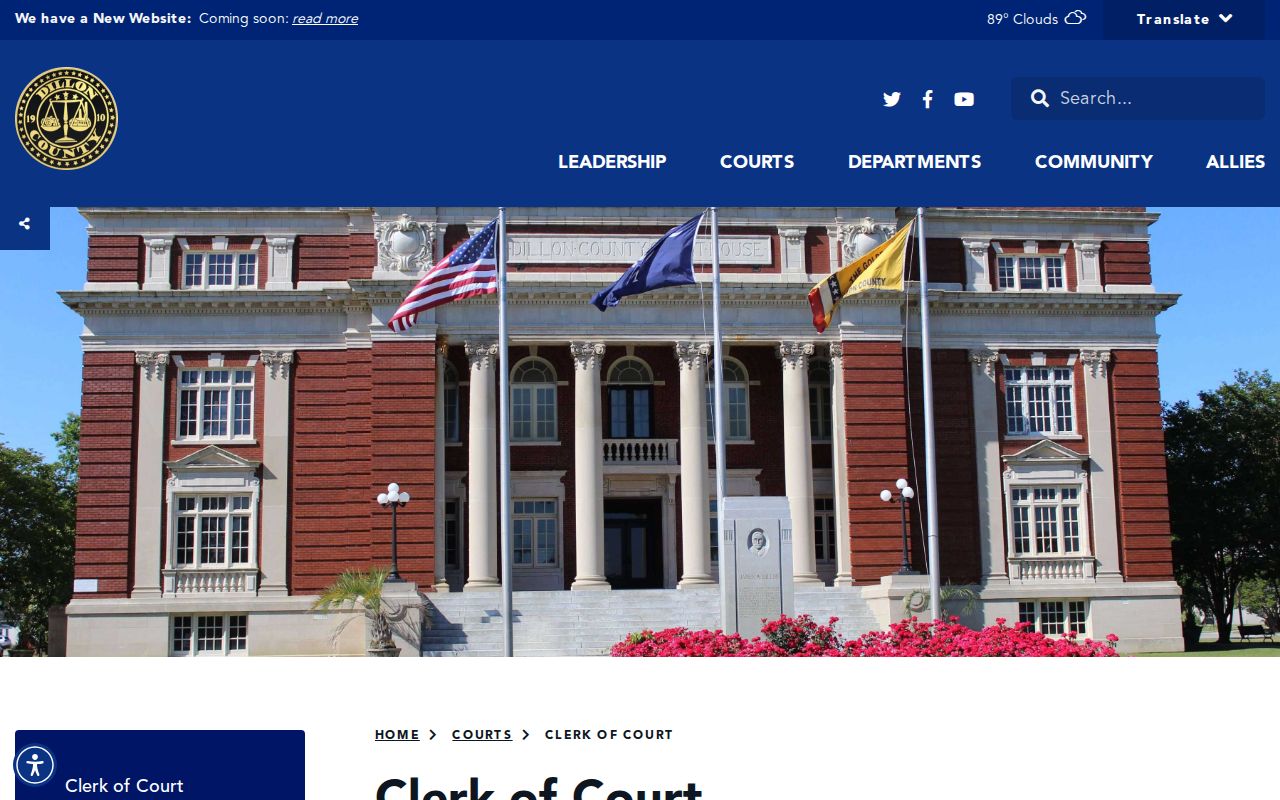
The clerk is the county source for case numbers, registers of actions, certified court material, and General Sessions disposition documents.
Sealed, Expunged, and Restricted Records
South Carolina expungement is based on the charge, result, prior record, and waiting period. Eligible General Sessions matters begin with the Fourth Judicial Circuit Solicitor for the county of arrest. A dismissed Dillon Magistrate Court or Dillon, Latta, or Lake View Municipal Court charge begins with the court that disposed of it. SLED cannot start the application and needs an Order for Destruction of Arrest Records before removing a charge.
General Sessions fee components published by the Judicial Branch include a $250 nonrefundable Solicitor administrative fee, a $25 SLED verification fee when applicable, and a $35 Clerk filing fee when applicable. Statutory exceptions can remove some charges. A qualifying summary-court dismissal, nolle prosequi, or not-guilty result uses the court process described by SCCA 223C and does not carry the Clerk filing fee under § 17-22-950.
Expungement does not mean every lawfully retained investigative file vanishes at once. Section 17-1-40 allows specified sealed retention for limited investigation, prosecution, administrative, or litigation purposes. Juvenile, medical, victim-sensitive, and court-sealed records also follow rules apart from ordinary public access.
Dillon County Historical Criminal Records
Dillon County was formed from Marion County in 1910. That date is a real research boundary. A historical case tied to land or people in the present county may predate Dillon's own court series and require a search in Marion County predecessor holdings. The South Carolina Department of Archives and History separately inventories Dillon Clerk of Court, Court of General Sessions, and county government records.
The current criminal courthouse and Judicial Center is at 1033 Old Latta Highway, while historical sources describe a 1911 courthouse. Researchers should not select a destination from a historic photograph or map pin. The live Judicial Branch directory and the Dillon County Clerk should settle where a current or archived file is handled.
The state archives Dillon County records guide shows the distinct historical record series.
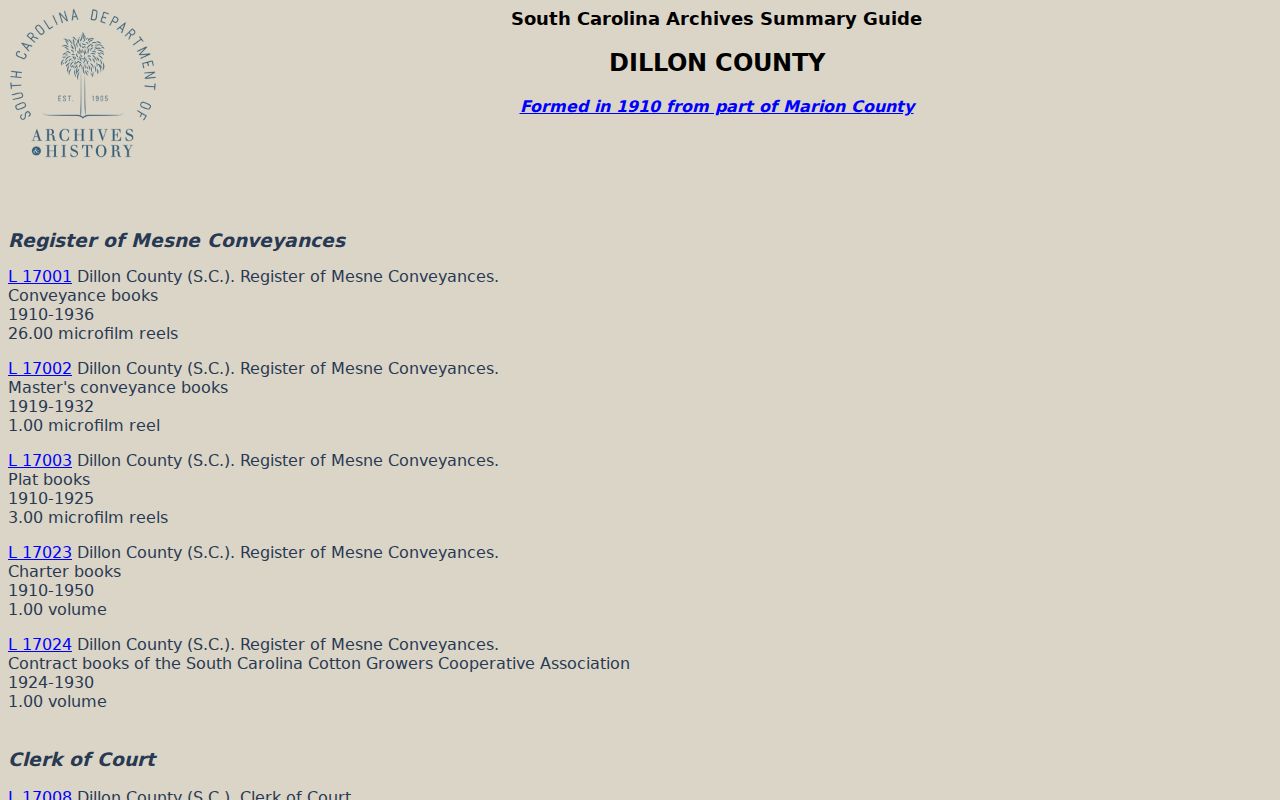
Its arrangement helps keep early General Sessions material separate from later agency and administrative records.
Criminal Records by City in Dillon County
Dillon County has three incorporated municipalities. City police departments keep their own incident reports, and each municipal court keeps its authorized summary docket. A city arrest may also create a Dillon County booking file and, for a more serious charge, a General Sessions case. The local path should therefore be checked before assuming every city record is in Public Index.
Dillon Criminal History
Population estimate 6,227. Dillon Police and Dillon Municipal Court are distinct from county custodians.
Latta Criminal History
Population estimate 1,235. Latta Police and Municipal Court provide direct local routes.
Lake View Criminal History
Population estimate 754. Town and Judicial Branch contacts fill the gap left by no local portal.
Who Holds Dillon County Criminal Records
The Dillon County Clerk, Sheriff or police agency, detention center, and SLED each own a different piece of the record trail. The clerk handles filed General Sessions material. The arresting agency holds its incident narrative. The detention center controls local booking and custody records. SLED maintains the state repository and SORT. The Fourth Judicial Circuit Solicitor handles prosecutions and eligible General Sessions expungement routes.
- General Sessions
- The criminal side of South Carolina Circuit Court for felonies and more serious criminal matters.
- Public Index
- The Judicial Branch search for county trial-court dockets, including Dillon General Sessions cases.
- CATCH
- SLED's paid public, name-based South Carolina criminal-history product.
- Disposition
- The court result, such as conviction, dismissal, acquittal, or nolle prosequi.
- Expungement
- A statutory process that destroys or removes qualifying records under an order and defined agency procedures.
A Dillon County criminal record is most reliable when its source and scope are stated. That practice keeps an arrest apart from a conviction and a custody notice apart from a full booking file.